Key takeaways
- The JLPT has five levels, N5 (beginner) to N1 (advanced), and tests Language Knowledge, Reading and Listening.
- Test time and pass marks differ by level, so plan your timing for the level you choose.
- JLPT N5 is accepted as A1-level proof for language school applications from the October 2026 intake.
- Check the official site for the current format and dates.
About this guide: written by the LALALA Nihon team. LALALA Plus Co., Ltd. has helped students apply to Japanese language schools since 2009, and our counselors have helped more than 1,000 students. This guide on the JLPT exam is based on trusted sources and our experience with students at Japanese language schools.
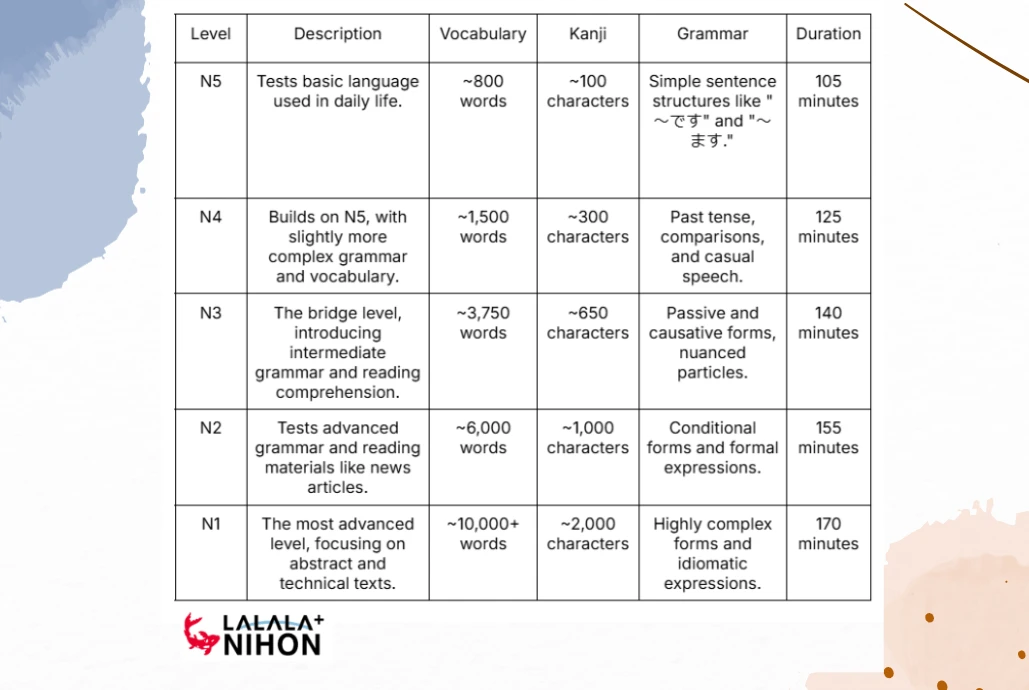
The Japanese-Language Proficiency Test (JLPT) is the most widely recognized exam for measuring Japanese language ability. It is divided into five levels, ranging from N5 (beginner) to N1 (advanced).

Photo: BREAKIFY on Unsplash.
Each level tests progressively deeper knowledge of the language, with N1 demanding near-native fluency and N5 focusing on fundamental basics.
The exam consists of three primary sections:
Language Knowledge (Vocabulary and Grammar)📚 Reading Comprehension🎧 Listening Skills
If you want to learn about how to register for the exam, please read to this article to learn more.
1. Language Knowledge (Vocabulary and Grammar)

Building a strong foundation in vocabulary and grammar is crucial for success in the JLPT.
More than just recognizing words, test-takers must understand their usage, nuances, and how they interact within sentences.
At the beginner levels, the focus is on common daily expressions and essential sentence structures that facilitate basic communication.
As one progresses, vocabulary expands to include more technical, formal, and idiomatic expressions. Advanced learners must be able to interpret subtle differences in phrasing and recognize context-dependent meanings.
Grammar evolves similarly. Early levels introduce sentence structures commonly used in casual conversation. Intermediate learners begin to encounter more complex forms that express reasoning, probability, and abstract ideas.
At the highest level, the focus is on refining understanding, distinguishing between nearly identical grammatical patterns, and using precise phrasing for academic or professional settings.
2. Reading Comprehension

Success in the reading section of the JLPT requires more than just knowing individual words—it demands the ability to understand context, extract key information, and process long passages efficiently.
Beginner levels introduce short, straightforward texts such as personal messages, announcements, and advertisements. Intermediate levels challenge test-takers with denser content like opinion pieces, workplace documents, and structured essays.
The highest level features complex texts covering academic discussions, political analyses, and technical reports.
The key to mastering this section is improving reading speed while maintaining accuracy, as well as recognizing implied meanings and logical structures within texts.
3. Listening Comprehension

The listening section of the JLPT is designed to test how well one can understand spoken Japanese in various real-life contexts. This can be particularly challenging due to differences in speed, intonation, and accents.
At the lower levels, audio clips feature slow, clear speech with common vocabulary. Speakers use direct phrasing, making it easier to follow along.
As difficulty increases, speech becomes faster and more natural, incorporating background noise, indirect responses, and varying levels of politeness. At the highest level, dialogues may contain overlapping speech, cultural implications, and subtle expressions that require careful interpretation.
Effective preparation involves extensive listening practice with real-world materials, such as news broadcasts, podcasts, and everyday conversations. Exposure to different speaking styles and settings helps build confidence in understanding Japanese at any level.
How LALALA Nihon can help you pass the JLPT Exam
After reading this article, it might seem scary and overwhelming to take the JLPT exam, but do not worry! If you are thinking about studying for the exam and moving to Japan, we can help make this dream come a reality. We partner with the best JPLT prep schools in Japan and also connect students to great online resources. Learn more about what we can do to help here. Plan your preparation around the test format. Study grammar and vocabulary in short daily sessions, practice reading passages against the clock, and listen to audio at normal speed. Take a full-length mock exam before the real test so you know how much time to spend on each section. The JLPT is held twice a year in July and December, so work backwards from the test date and register early because seats are limited. If you study at a language school in Japan, ask your teachers for past-paper practice and feedback. On test day, bring your admission ticket, photo ID and pencils, arrive early, and read the instructions carefully, because the listening section starts on schedule and cannot be paused. For reading, skim the questions first and then look for the answers in the text so you do not run out of time. Whatever your result, review the sections where you lost points before you choose your next level.
Test sections, time and pass marks by level
| Level | Total test time | Total score | Pass mark |
|---|---|---|---|
| N5 | 105 minutes | 180 | 80 |
| N4 | 125 minutes | 180 | 90 |
| N3 | 140 minutes | 180 | 95 |
| N2 | 155 minutes | 180 | 90 |
| N1 | 170 minutes | 180 | 100 |
You must also reach the minimum score in each scored section, so a high mark in one section cannot cover a very low mark in another. These figures come from the official JLPT information, which can change, so confirm them before you register.
How to prepare for each section
- Vocabulary and grammar: learn words by level, review them daily, and write your own example sentences for each grammar point.
- Reading: practice short passages under time pressure and learn to find the answer in the text instead of reading every word.
- Listening: listen to audio at normal speed and train yourself to catch key information such as numbers, times and reasons.
Test day checklist
- Test voucher and a valid photo ID.
- Pencils and an eraser, since answers are marked on a sheet.
- A watch that is not a smart device, and arrive early.
Frequently asked questions
What are the sections of the JLPT?
The JLPT tests Language Knowledge (vocabulary and grammar), Reading and Listening. N4 and N5 combine vocabulary, grammar and reading differently from N1 to N3, so check your level's format.
What score do I need to pass the JLPT?
Pass marks are 80 for N5, 90 for N4, 95 for N3, 90 for N2 and 100 for N1, out of 180, and you must also meet the minimum in each section.
How long is the JLPT?
It ranges from 105 minutes for N5 to 170 minutes for N1, including all sections.
Related guides
- JLPT Exam ID Requirements: What to Do If You Lack ID
- JLPT Preparation: Finding Help and Studying in Japan
- How to Test Your Japanese Level
- EJU Exam Guide: Subjects, Preparation, and Study Tips
- Moving From the US to Japan: A Planning Guide
- Studying Game Design in Japan: Schools and Career Paths
Further reading
- Japanese-Language Proficiency Test (JLPT) official site
- How to apply for the JLPT
- JLPT preparation help
Want to study in Japan? See our partner language schools, our student resources, or book a free consultation with LALALA Nihon.
LALALA Nihon helps you compare schools, plan your budget and apply for 2027 intakes, with free multilingual support on applications, visas and student life.